What Is Energy?
We always talk about it, but only a minority of people actually understand its real and profound meaning.
Every activity, process, living being requires some form of Energy. But what really is Energy? Although unknown to most people, the answer is simple and profound. Let's dig deep.

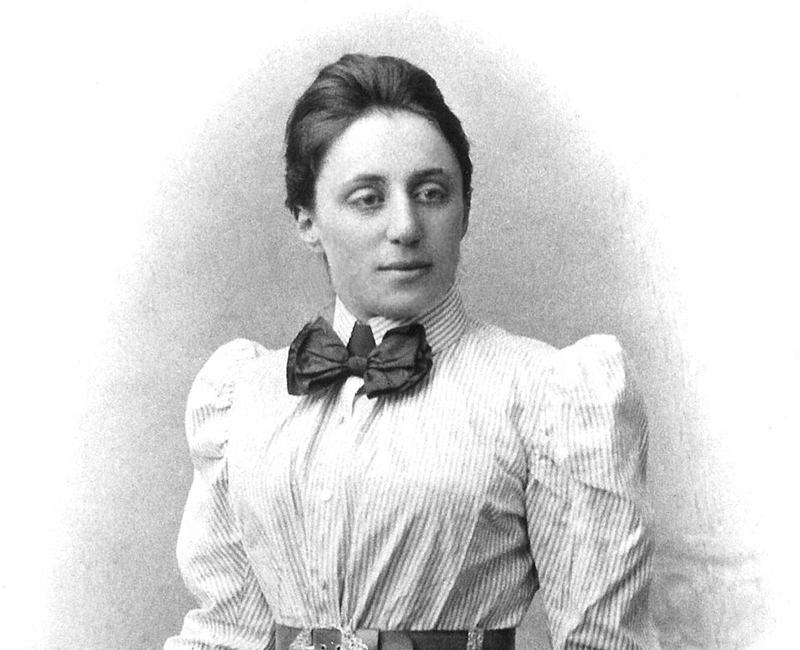
If you are trying to understand what is the relationship between the topic of this article (Energy) and the header picture of this article, you probably don't know one of the greatest mathematicians of all time, Prof. Emmy Noether.
In spite of the tremendous discrimination that Emmy Noether had to endure witnessing for just being a woman, her contributions are central to all modern physics and our very understanding of reality at the fundamental level. In particular, a key contribution is related to her homonymous theorem that associates continuous symmetries with conserved quantities, that for the first time shed light on the concept of Energy. It may seem quite abstract right know, but please be patient. Let's go through the meaning of each term for the layperson.
What is a Symmetry?
The term Symmetry comes from the fusion of two Greek words, namely syn- "together" and metron "measure", to indicate a common measure, even, proportionate. We all understand symmetry, although often implicitly, since it typically leads to a sense of harmony, beauty and balance. In mathematics, the term usually refers to the (property of) invariance of an object under some operation (transformation), such as reflections, rotations and translations.
You have a generic object, you apply an operation to it, and if the object does not change it means it is symmetric with respect to such operation/transformation.
For instance, our face/body is (roughly) invariant under reflection, that is, our face/body does not change (appreciably) if you swap left and right sides (mirror image). You may recognize that this is common for almost all living beings.
This is clearly an approximate symmetry, but for mathematical objects, symmetry may become exact. A sphere is (exactly) symmetric with respect to many transformations: for instance, it does not change if you rotate it (by any angle) or reflect it.
The concept is much more general, and applies to the most profound aspects of our knowledge. As wrote by the Nobel laureate in Physics, Philip W. Anderson, in a popular Science article:
By symmetry, we mean the existence of different viewpoints from which the system appears the same. It is only slightly overstating the case to say that physics is the study of symmetry.
Anderson, P. W. (1972). More is different: broken symmetry and the nature of the hierarchical structure of science. Science, 177(4047), 393-396.
It is nowadays clear that practically all laws of Nature originate from symmetries. This is certified by their pivotal role in our most successful (and fundamental) theories, described in terms of fields (things that are present throughout all space, including empty space): the Standard Model of particle physics and General Relativity.
In particular, our best theories are both based on
- continuous symmetries, associated with transformations that can apply infinitesimally small changes to an object (e.g., the rotation of an object by any angle is a continuous transformation);
- discrete symmetries, associated with a discrete number of changes (e.g., reflection is a discrete transformation).
The concept of Energy at the fundamental level
As mentioned in the introduction, Noether's theorem essentially states that for each Law of Nature (expressed by a specific mathematical equation, typically a so-called Lagrangian) having a continuous symmetry, there is a corresponding conserved quantity.
Well, according to such theorem, it turns out that
If a Law of Nature is symmetric with respect to time (does not change with time), the conserved quantity (a number) is what we call Energy.
So simple, so profound. This is just one example of the key consequences of Noether's Theorem. For instance, a spatial symmetry leads to conservation of another quantity called momentum (which is why it is much less dangerous for us to collide with a fly rather than a TRUCK going at the same speed...). And indeed, this theorem is just one of the key contributions that Prof. Noether gave to humankind.
If you doubt about my personal opinion, please read this struggling and profound NY Times obituary (published on May 4, 1935) written by Albert Einstein to honor her life and legacy:
The efforts of most human-beings are consumed in the struggle for their daily bread, but most of those who are, either through fortune or some special gift, relieved of this struggle are largely absorbed in further improving their worldly lot. Beneath the effort directed toward the accumulation of worldly goods lies all too frequently the illusion that this is the most substantial and desirable end to be achieved; but there is, fortunately, a minority composed of those who recognize early in their lives that the most beautiful and satisfying experiences open to humankind are not derived from the outside, but are bound up with the development of the individual's own feeling, thinking and acting. The genuine artists, investigators and thinkers have always been persons of this kind. However inconspicuously the life of these individuals runs its course, none the less the fruits of their endeavors are the most valuable contributions which one generation can make to its successors.
Within the past few days a distinguished mathematician, Professor Emmy Noether, formerly connected with the University of Göttingen and for the past two years at Bryn Mawr College, died in her fifty-third year. In the judgment of the most competent living mathematicians, Fräulein Noether was the most significant creative mathematical genius thus far produced since the higher education of women began. In the realm of algebra, in which the most gifted mathematicians have been busy for centuries, she discovered methods which have proved of enormous importance in the development of the present-day younger generation of mathematicians. Pure mathematics is, in its way, the poetry of logical ideas. One seeks the most general ideas of operation which will bring together in simple, logical and unified form the largest possible circle of formal relationships. In this effort toward logical beauty spiritual formulas are discovered necessary for the deeper penetration into the laws of nature.
Born in a Jewish family distinguished for the love of learning, Emmy Noether, who, in spite of the efforts of the great Göttingen mathematician, Hilbert, never reached the academic standing due her in her own country, none the less surrounded herself with a group of students and investigators at Göttingen, who have already become distinguished as teachers and investigators. Her unselfish, significant work over a period of many years was rewarded by the new rulers of Germany with a dismissal, which cost her the means of maintaining her simple life and the opportunity to carry on her mathematical studies. Farsighted friends of science in this country were fortunately able to make such arrangements at Bryn Mawr College and at Princeton that she found in America up to the day of her death not only colleagues who esteemed her friendship but grateful pupils whose enthusiasm made her last years the happiest and perhaps the most fruitful of her entire career.
Thanks, Prof. Noether.
Find more blog posts with similar tags